
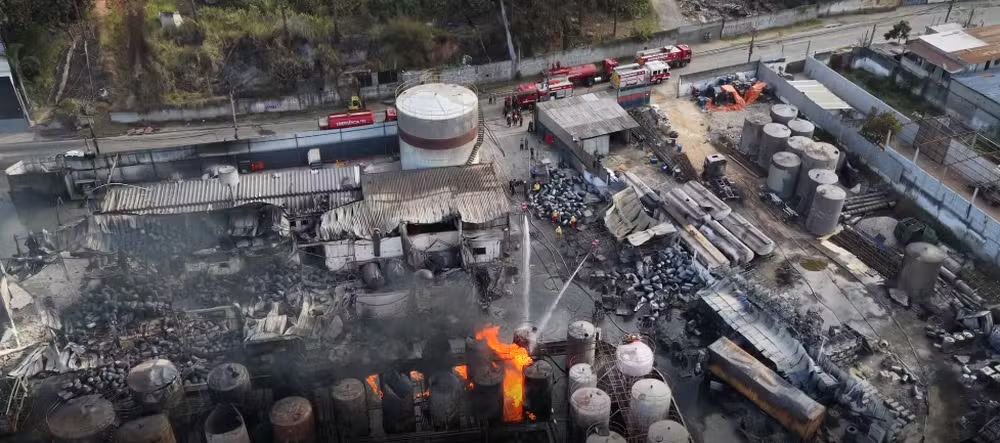
Drones help fight fire at chemical plant in Itaquaquecetuba.
Drones helped the Fire Department fight the fire that hit a chemical plant in Itaquaquecetuba, In Greater São Paulo, the technology allowed water to be dropped on fires in hard-to-reach areas and reduced the need for firefighters to approach the highest-risk points during the operation.
➡️ The fire started on Tuesday afternoon (4) and was brought under control around 00:10 this Thursday (6), after about 33 hours of fighting. In total, 95 firefighters and 33 vehicles participated in the operation, according to the Fire Department. There are no reports of injuries.
During the operation, drones raised the water level and directed the jet towards the hotspots in hard-to-reach locations. This allowed firefighters to combat the fire without approaching the areas of greatest risk. The flames reached 24 tanks storing flammable liquids.
The factory stored approximately 2 million liters of flammable products, such as toluene, hexane, ethyl alcohol, ethyl acetate, butyl acetate, and resins.
/i.s3.glbimg.com/v1/AUTH_59edd422c0c84a879bd37670ae4f538a/internal_photos/bs/2026/Y/w/BAfif3R6mnsuVGJf5CAQ/redimensao.png)
Drones help fight the fire in Itaquaquecetuba — Photo: Reproduction/UAVI
🚒 How do drones used in firefighting work?
The drones used in the operation are the UAVI 100 Bombeiro model, developed in Brazil to combat urban and industrial fires, as well as fires in hard-to-reach locations.
The equipment works by connecting to a pressurized hose, which is attached to a fire truck, hydrant, or pumping system. During operation, the drone raises the hose and directs the jet of water or the firefighting solution directly to the fire's hotspots.
🎥 The drone also features a thermal camera, a conventional camera, a lighting system, and eight independent electric motors. These features help teams identify fire hotspots and guide operations.
According to the company responsible for the equipment, the model is authorized by the National Civil Aviation Agency (ANAC) to operate in this category and is already used by the Fire Departments of states such as Amazonas and Mato Grosso in fire incidents.
/i.s3.glbimg.com/v1/AUTH_59edd422c0c84a879bd37670ae4f538a/internal_photos/bs/2026/A/V/D9wBslTt6ysm7wBBsABQ/drone-via.png)
Drones fighting the fire at the chemical plant in Itaquaquecetuba — Photo: Reproduction/UAVI
According to the São Paulo State Military Police Fire Department, the drone was used after the fire was brought under control, during the fight against remaining hotspots.
The equipment underwent a technical evaluation so that the corporation could observe the technology's performance in a real-life scenario, without interfering with the operation's main strategy.
Among the points analyzed were the reach, stability, precision of water application, and the possibility of operating in areas that are difficult to access or pose a greater risk to the teams.
The Fire Department reported that the equipment belongs to the developing company and, for the time being, is not part of the department's operational fleet.
What the company says
In a statement published on social media, Quema Química reported that the fire at the Itaquaquecetuba unit was controlled by the Fire Department around 11 pm on Wednesday (5) and that there were no deaths or serious injuries among employees, service providers and residents of the region.
The company stated that it is cooperating with authorities in investigating the causes and is monitoring air and soil quality in conjunction with environmental agencies. According to Quema, containment measures are also being implemented.
The company also reported that it resumed chemical and resin operations at the Itaquaquecetuba unit on Friday (7) and that it intends to start selling thinners on Thursday (13). The company's other units remain in operation.
*under the supervision of Gladys Peixoto
/i.s3.glbimg.com/v1/AUTH_59edd422c0c84a879bd37670ae4f538a/internal_photos/bs/2026/y/J/2XApALRvaSzBLZI30f9g/img-4674.jpeg)
Drums were destroyed after a fire in Itaquaquecetuba — Photo: Theo Leite / Personal archive